Showing posts with label books. Show all posts

Saturday, January 3, 2015

The Road Goes Ever Ever On

In case you haven't seen the movie yet - spoiler alert! Also, you can see my reviews of the first two films here and here.

The Hobbit: The Battle of The Five Armies marks the end of an era that began thirteen years ago with The Fellowship of the Ring. It makes seeing this movie and talking about it a little sad - it's all over! As a fan, in spite of my reservations about (and outright objections to) Peter Jackson's interpretations of J. R. R. Tolkien's stories, it is hard to approach this film with anything resembling objectivity. Knowing that it is the last one* makes it all the more difficult.

BotFA is the only one of Jackson's six Tolkien films that I did not see on opening weekend. Partly because work has been so busy, partly because I have a toddler, and partly because this holiday season was a little more hectic than usual, I just did not have the time to see it right away. But there was another thing that held me back: I was simply reluctant to get out there and put a final end to all of the hopes that I had had for these six movies.

Before FotR was released in 2001, the anticipation of what these films might look like, how the stories would be adapted, and how these movies would be received thrilled me and my friends, and speculating about all of these things was an endless source of excitement. So when The Hobbit was announced as a two-movie treatment (later updated to three), my enthusiasm was rekindled. But after five films had come and gone, my own hopes and dreams for these movies had been thoroughly replaced by the reality of PJ & Company's imaginings. There is a colonization of sorts that takes place when you see someone else's interpretation of a beloved work, and part of me wanted to keep alive the visions I had for a film version of The Hobbit by holding off seeing BotFA for just a little longer.

Of the three Hobbit movies, I enjoyed BotFA most. The high notes of the film - the dragon's assault on Laketown, the dwarven phalanx facing off against superior numbers, the death of Thorin, Bilbo's return to the Shire - brought the story to a satisfying conclusion. But I can't sit here and say it was a good movie: once again, it neglected its own story, cluttered itself with way too much action, and depicted far too many physics-free CGI acrobatics performed by Legolas. And significantly, by appropriating Tolkien's supplementary material to address plot issues in the original tale, the filmmakers wound up introducing more problems than they solved (I'm thinking here of the Arkenstone, the Battle of Dol Guldur, Thorin's madness, and the Earth-Eaters aka Were-worms).

For me, the best scene in this film comes about halfway through: Bilbo, having realized that Thorin has succumbed to his madness and greed (the "dragon-sickness"), decides to slip away and meet with Bard and the Elven-king Thranduil in order to give them the Arkenstone - the jewel with which they might barter for a peaceful settlement. The writing was straightforward and Freeman's note-perfect performance restored a breath of fresh air into the overwrought action and stuffy haughtiness that fills too much of the movie. It needed more of this plain Hobbit sense.

I thought the opening action was great, but it wasn't really a movie opening: it was the end of the last film. In fact, BotFA is the only film of the six that doesn't have a true opening sequence. I guess that makes sense, given that the last movie didn't really have an ending. It speaks to the problems of writing two movies and then expanding the story into three.

There are plenty more nits I might pick, but as I said, overall, I enjoyed the experience of seeing this movie - as a fantasy-action film, it has a lot to recommend it. Looking at the series as a whole, my main gripes can be summed up very succinctly: (1) PJ & Company needed to answer more of the questions that their own script posed, and (2) they needed to dial back (and even remove some of) the extended CG sequences, especially those which ignore the Laws of Motion. As for my second point, given Jackson's work in the 21st century, I can say with tolerable certainty that he's just not going to make this change -- he's too enamored of those tricked-out antics. But as for the first, it needed to happen in order for the Hobbit Trilogy to really shine, and the biggest disappointment is that they didn't do more with such great source material.

ETA: apparently, Aragorn agrees with me:  "Mortensen thinks - rightly - that The Fellowship of the Ring turned out the best of the three, perhaps largely because it was shot in one go... "Anybody who says they knew it was going to be the success it was, I don’t think it's really true," he says. "They didn't have an inkling until they showed 20 minutes in Cannes, in May of 2001. They were in a lot of trouble, and Peter had spent a lot. Officially, he could say that he was finished in December 2000 - he'd shot all three films in the trilogy. The first script was better organised... really the second and third ones were a mess and needed massive reshoots... " he says. "Also, Peter was always a geek in terms of technology but, once he had the means to do it, and... the technology really took off, he never looked back. In the first movie, yes, there's Rivendell, and Mordor, but there's sort of an organic quality to it, actors acting with each other, and real landscapes; it's grittier. The second movie started ballooning... and then by the third one, there were a lot of special effects. It was grandiose, and all that, but whatever was subtle, in the first movie, gradually got lost in the second and third. Now with The Hobbit, one and two, it's like that to the power of 10."

Not all that is gold glitters, my friend. 

*Note: Some have speculated that there will be more films and/or a reboot. They are almost certainly right. But Peter Jackson has pretty much exhausted the Middle Earth materials that he has the legal right to depict on film. So unless and until the rights to The Hobbit and LotR are secured by someone else, PJ & Company's work will stand as the definitive films. And given how many artists and craftsmen were involved with the making of these movies, and their care and attention to a myriad of details, it's not difficult to imagine that the influence of these films will weigh heavily on any attempt at a new telling of the story in the medium. 

Sunday, December 15, 2013

The Hobbit, Part II: Light My Fire

There might be spoilers ahead. I'm not sure; I haven't written it yet. I'm probably one of those reviewers that you should read after you've seen the movie. (And then you can say to yourself, 'this dude is full of it.')

Peter Jackson just cannot help himself. He is going to work a lengthy, physics-defying, CG-fueled carnival ride into his movies. Probably more than one. He's going to do it whether it serves the story or not. And at this point, there is nothing you or I can do to stop it. As it happens, these sequences are usually fairly entertaining as spectacle, but because they have no relationship to the laws of motion or to gravity as we know it, they tend to leave the viewer with a somewhat empty, unsatisfied feeling afterward. For better or worse, as a maker of blockbuster fantasy-action movies, this has become his style, his signature. So I just have to get over it: this is him, this is what he likes, and he made a gazillion dollars doing what he does; the chances that my complaints about it will be heard or heeded are exactly zero.

Last year I wrote a mostly positive review of The Hobbit: An Unexpected Journey. Looking back, however, my review glosses over the film's shortcomings and emphasizes its strengths -- in short, it is a fan's review. Whatever, I guess: I make no apologies for being a Tolkien fanboy of the highest order, and I will always have a soft spot for PJ for having the vision and fortitude and audacity to make The Lord of the Rings. Many have said it before, but it bears repeating: it's easy to forget how big a risk that first trilogy was. So I approach his movies with gratitude.

All of this is prelude to discussing The Hobbit: The Desolation of Smaug. I enjoyed the second installment of the Hobbit trilogy as an entertaining cinematic diversion. It's better than An Unexpected Journey: it opens briskly and sets a steady, uptempo pace that does not get bogged down with two opening sequences and endless exposition like the first film did. I left the theater well-pleased; I had a great time with the friends who joined me to see it. So that's a recommendation: it's a fun holiday movie for the gang.

But I suppose I should say more...

Once again, Jackson & Company teased out some interesting interpretations of the source material, and conjured a new character that fits pretty well into the narrative. But also once again, Jackson seems to believe that you can't have too much of a good thing. Insert witticisms about barrel-riding and ax-juggling and elf-assassins and molten-river-of-gold-boogie-boarding here. 

Jackson seems to have a lot of trouble translating Tolkien's antagonistic minor characters onto screen without turning them into villainous caricatures. In Return of the King, the noble but tragically flawed Denethor became a cartoonish bad guy. In Desolation of Smaug, Thranduil vamps his way through his scenes: he does not evoke an ancient and wise king who will join forces with the dwarves to put down the goblin army, nor hold Gollum captive, nor send his only son to represent the woodland realm later in the epic. He says, "a hundred years is nothing to an elf," but his arch, sullen countenance expresses anything but patience. I think Jackson would do well to study the antagonists in some of Hayao Miyazaki's films to discover subtlety for characters such as these. 

Another thing that bothers me is Jackson's camera work: he seems to be enamored of closeups shot with a wide angle lens, which leaves his subjects oddly misshapen and the screen cluttered. This might be right for orcs and goblins, but it just doesn't fit for Bilbo. It's too chaotic, and doesn't visually express the plain, sensible wisdom of Hobbit-folk.

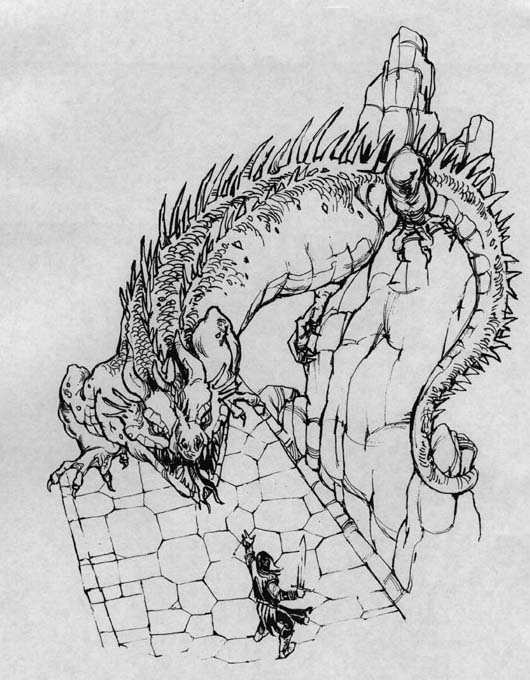
When I first saw the trailer for Desolation, I was dumbstruck: the dragon looked bad. I thought, wtf, he looks no better than Draco, and Dragonheart is now seventeen years old. How could that happen? Hell, after that glimpse, I felt they might have given Vermithrax the nod in favor of what they came up with. Happily, my fears were unfounded. On screen, Smaug is fantastic; the cunning, terrible menace of the character absolutely dominates the last quarter of the film. And the decision to have the dwarves make a stand to reclaim their kingdom in an extended fight with the dragon was a smart one. It is the execution where this falls flat: once again, heavy reliance upon physics-free CG leaves the sequence light on dramatic heft.

In FotR, one of the reasons that the confrontation with the Balrog succeeds is that it is situated in a film that has plenty of set-pieces that do not rely solely on special effects. Here in Desolation, Gandalf's showdown with the Necromancer has no such grounding context; it's just another CG fireworks display, which significantly diminishes its impact. It's just more noise in a spectacle already turned up to 11.

After five movies, The Fellowship of the Ring remains PJ's strongest foray into Middle Earth. In FotR, I really felt transported -- New Zealand's primal beauty played a major part in establishing an otherworldly yet realistic setting. The subsequent films have slowly morphed Middle Earth into an almost wholly CG creation that might have been filmed anywhere. More's the pity.

What did you think?

Friday, November 22, 2013

Katniss Everdeen: Feminist Icon, or Yet Another Sexist Stereotype?

Given how much has been written about how Katniss is a "strong female character," and given how invested a lot of women (both young and old) are invested in Suzanne Collins's trilogy, who am I to even ask this question? The idea that anyone could argue that The Hunger Games is a sexist fairy tale seems completely crazy. Katniss is the hero! But once I was presented with the evidence, I have found it difficult to unsee.

Let me back up: some time ago, I stumbled across a contrarian blog that has alternately challenged, maddened, and astonished me with its alien worldview. The writer's insights are always provocative and wildly defiant of expectations. And it was here that I discovered a lonely voice lamenting that, if the cause of feminism is being advanced by Collins's Hunger Games, then there has been no progress. Here is an extended excerpt from the essay to give you an idea of what this person could possibly be talking about.
[This is] a book about a post-apocalyptic killing game that spends zero pages describing how Katniss kills anyone but spends countless pages on how she is dressed, how everyone is dressed. What will she wear? What kind of jewelry? Hair up? Will the "sponsors" like her better this way or that? Her chief weapon isn't a bow, it's her appearance.

This is also a good place to observe that the real life, pre-and post movie release controversies about The Hunger Games have also been about physical appearances -- not just race, but is 'Jennifer Lawrence too tall? Hair too blonde?'

[Katniss] does not choose NOT to kill, she does not choose a pacifist position; she explicitly states in the book how much she wants to kill. But she never [premeditatedly kills anyone]. She tries to kill Cato at the end, twice, and fails. Only after he is torn to shreds by mutants does she perform a mercy killing on him, at his request. In other words, she doesn't choose to kill or not kill -- it doesn't come up.

Katniss is continuously saved by men -- Haymitch, Peeta, Thresh -- but you don't notice that she saves no one***, including herself; you think she saves herself all the time. You think this because of the first half of the movie told you she's a badass, so you don't realize that during the second half she shows less agency than Princess Jasmine...

Haymitch, played by a man, says this to a woman, played by Katniss:
You know how you stay alive?  You get people to like you. Oh, not what you were expecting?
No, unfortunately it's exactly what I was expecting.  Thanks Dad.

...This is bigger than Katniss, this is the state of human progress. If it helps, imagine you have a five year old daughter you have to raise in the midst of aspirational images with long legs and no power of agency, and your worry is no longer "will she grow up and find a job?" or even "will she grow up and get married?" but [instead, your worry is] "will she be so conflicted about herself that she is unable to choose a career or pick a nice man from the hundreds of options that present themselves to her because she is ever anxious that any choice is the wrong choice because she only gets conflicting messages from everyone on earth?"

That's the world I'm stuck in, and though I haven't burned a bra in years I do somewhat rely on feminists to nudge the bar consistently higher so my theoretical daughters don't have to rely on penis or Prozac to live happily ever after. So where my girls at? I found about a million fawning feminist reviews of The Hunger Games which all contain some version of this paragraph:
Katniss, in this season of woman-hating, is a stunning example of feminism at its finest hour. She is compassionate, yet strong. She deeply about her family. While she is tempted to run away with Gale, instead of leaving her sister and mother to fend for themselves, she stays to support them.
...None of those things are feminism, those aren't even praiseworthy.  Those are basic, ordinary, unremarkable characteristics of every reasonable human being for 6000 years, and all animals. But that's the bar the reviewer has set for Katniss, for feminism.  That's the fantasy world she'd like to see women eventually get to. So either a) she has an unconsciously cynical view of women in general; or b) she has been tricked by the system about what it is to advance as a woman, i.e she's in The Matrix... If I was a 15 year old girl, and I'm not saying I'm not, then what is being communicated to me by the feminist praise of this book is that my future expectations are low.
Full disclosure: I never read the books; I only saw the first film (and I do plan to see all of them). Before I saw this critical analysis, though, I was content to join the chorus of admirers who point to Collins's work as a satisfying development in the portrayal of gender roles in narrative fiction. But the universal, explicitly pro-woman praise of this work has a big hole in it, and The Last Psychiatrist is the only person I've seen to point it out.
Please, please, don't misunderstand me, I have nothing against The Hunger Games, it's an entertaining story, I am not criticizing the book... If it won an Oscar or the world declared this the next Star Wars and made action figures and lunchboxes I wouldn't say a bad word about it, what's it to me if it makes people happy?  Enjoy what you like, it doesn't have to have deep meaning to be worthwhile.

But what makes me reach for the now empty bottle is how women have convinced themselves and each other that this is a pro-feminist story.
Anyway, go read the whole thing (there are actually two essays, but I'm linking to the second one, because it's a little more direct), and tell me what you think. A final warning, though: the writer is pretty in-your-face. I deliberately removed some of the language that is hostile to the reader.

I'll have more to say about The Last Psychiatrist later.

***Update: I had a very lively discussion about this post and about TLP on social media. No one who commented bought this reading of the story, and all strenuously defended Katniss as a strong female hero. In the course of the discussion, one commenter pointed out that Katniss does indeed save Peeta by retrieving the medicine from Cornucopia. So at least on that point, TLP is incorrect (though maybe he or she had an explanation for ignoring or excluding that instance of Katniss' heroism). Also, I added an important passage that was missing from my original excerpt.

Update II: one commenter on the thread suggested that TLP is simply an anti-feminist troll. TLP may be a troll (and I plan on talking about that if I ever get around to finishing my next essay on TLP), but I have a hard time believing that TLP is anti-feminist: no anti-feminist I know of uses critical literary theory, refers to "partial objects," deconstructs porn (as the writer does elsewhere), and name-checks Lacan. That's pretty heady stuff. If TLP really is an "anti-feminist," it must be said that underneath the sodden, confrontational humor of the prose, he or she has a pretty deep knowledge of feminist thought. 

Update III: TLP has a new post about Hunger Games that came out a couple weeks back, but somehow I missed it. It's the shortest and sharpest yet. 

Thursday, October 24, 2013

The Hammer Salesmen Keep Seeing Nails

It's not an exaggeration to say that Richard Dawkins and Sam Harris changed my life. Before I read The God Delusion and Letter to a Christian Nation, I was merely a lapsed Catholic. But reading these books gave me permission to openly self-identify as a secularist/atheist/agnostic. So I must admit to having a bit of a soft spot for these authors. Unfortunately, I have to call them both out for being jackasses, because sometimes that's what one must do in order to be intellectually honest.

First, in a recent interview, Richard Dawkins tells some anecdotes in which he implies that he does not condemn sexual harassment or pederasty. Okay, I kinda-sorta get what he's saying, so it isn't completely incomprehensible. But for the love of FSM, is this what you think is important to say right now? Is this the highest moral purpose you aspire to in these times - to defend anonymous perps on the basis of "different standards"? Yeesh. You're trolling us, Richard.

Now, I see that Sam Harris has decided to make a meal out of Malala Yousafzai, the teenage girl who was shot for speaking out against the Taliban. Harris seems to be willing to sacrifice anyone and anything in the service of his rhetorical cause. I'm afraid that others who have criticized Harris for rigidity and absolutism are right. Dear Sam: you wrote a great book, and you make some interesting points. But when you appropriate the courageous work of a young Muslim girl in order to make your point that Islam is Evil, well... it might be time to put down the computer and go outside for a while.

Grow up, fellas. We need you. 

These days, I find James Carse more compelling.

Wednesday, November 30, 2011

Now I'm a Believer

A couple of years back, a friend recommended a book to me - James Carse's The Religious Case Against Belief. I recently got around to reading it, and found it to be an engaging, worthwhile experience.
God said it - I believe it - that settles it.
       
- bumper sticker
So begins the book. Carse sets out to disentangle "religion" from "belief", which are not the synonyms I (and most people) take them to be. For him, this is no mere academic exercise: it can be argued that conflicting religious beliefs are responsible for much of what is shocking and violent in our world today, and he wants to draw a sharp distinction between the two.

Carse argues that belief marks a boundary beyond which thinking and questioning and exploration cease. For a believer, there is nothing beyond his own beliefs. Religion, on the other hand, is surprisingly difficult to define; he writes that it is an ethereal and mysterious and enduring phenomenon, in which its practitioners strive for knowledge without ever reaching it.

The author posits that the great religions of the world have thrived not because of their legions of believers, but because of vital conversations within themselves about their own meaning. Using his expansive knowledge of history, he illustrates that the result of these religious dialectics is what he labels the "poetry of religion." In striving for the infinite, there can be no boundaries, no ultimate truth; only horizons and contexts.

Carse spends a great deal of energy developing his definition of belief in order to distinguish it from religion. He starts by enumerating three types of ignorance: ordinary, willful, and "higher". Ordinary and willful ignorance are self-explanatory, but this last form was unfamiliar to me. He states that "higher" ignorance is a form of mental discipline in which a person has come to practice intellectual humility and honesty in the presence of a vast and unchartable universe. The money quote: "knowledge is corrigible, belief is not."

He goes on to say that willful ignorance is the cornerstone of belief systems. For Carse, belief has a limit imposed by some authority (a text, a person, an idea), and its effectiveness as a system is in securing its intellectual borders and defining its limits:
Once believers have selected their authority, genuine dialogue is abandoned. Discourse does not take its own spontaneous path but is aimed always at correcting and strengthening the existing thinking of those who already believe. Indeed, an attempt at genuine dialogue within a belief system can be taken itself as an act of unbelief.
Belief needs and thrives on opposition, because only walls that are being attacked need defending. He further states that because of this rigidity, belief systems actually contain the seeds of their own demise.
Believers and warriors tend to merge into one another: the military sees itself in religious terms, while believers take on the images of warfare.

[Belief systems] have an absolute commitment to their own orthodoxy, something missing in all the great religions... For all of their apparent worldly power, they are surprisingly fragile.
In striving to distinguish these two related yet (for him) oppositional words, he actually lights upon a compact and almost elegant definition of evil: "evil find its perfect home in our own belief system and the moral certainty that goes with it."

As his distinction between belief and religion become clear, the book develops the idea of the human institutions that make a body of believers vs religious adherents. He uses the terms civitas and communitas to speak about these groups. He begins to examine just how difficult it is to define "religion" and what it encompasses. He uses some iconic historical figures: Galileo, Martin Luther, Abraham Lincoln, and even Jesus to help illustrate his message about the gulf between religion and belief.

My greatest critique of Carse's work is that while his distinction between religion and belief may be meaningful and fairly well-established among scholars of religion, my experience with these phenomena in the wider world is that the two are almost hopelessly entangled. And while his definition of belief is compelling, he goes a bit too far when he tries to categorize scientific pursuits with it.

All that said, Carse's work is a good reminder that religious tradition and experience has a richness and depth and eloquence that resonates with people.

Saturday, May 31, 2008

He's Got A Point

A friend gave me Black Swan Green for my birthday. I just started it and it's good so far. Early in the book, Jason, the story's twelve-year-old narrator, dismisses the plot of Superman II with a keen observation:
Clark Kent gives gives up his powers just to have sexual intercourse with Lois Lane in a glittery bed. Who'd make such a stupid swap? If you could fly? Deflect nuclear missiles into space? Turn back time by spinning the planet in reverse? Sexual intercourse can't be that good.
Hard to argue with that.

Monday, April 21, 2008

Tagtastic

Not a day passed when he did not fulminate against Batista (That ox! That peasant!) or Castro (The goat-fucking comunista!) or CIA chief Allen Dulles (That effeminate!), who had failed to stop Batista's ill-advised Mother's Day Amnesty that freed Fidel and the other moncadistas to fight another day.
Needless to say, I've been tagged. Lately I haven't been keeping with my bloggerly duties. The rules...

1. Pick up the nearest book (at least 123 pages).
2. Turn to page 123.
3. Find the 5th sentence.
4. Post the 5th sentence on your blog.
5. Tag 5 people.

The passage was taken from The Brief Wondrous Life of Oscar Wao, by Junot Diaz. Great book, by the way. I highly recommend it. I still haven't written my review of it. So sue me.

I tag LLTK, JFB, Lacifer, Miz Verde, and Onion Town.

Thursday, February 21, 2008

Immoral Majority

Sam Harris' tiny volume Letter to a Christian Nation deals a crippling blow to the idea that religion, especially Christianity, is a force for moral good. While Richard Dawkins pursued a broad-based intellectual argument against belief in god, Harris cuts right at the heart of the supposed strength of religion: morality. Using simple examples and clear language, he relentlessly dismantles notions of divine morality.

In one deft passage, he starkly contrasts that which science offers to humanity with that which religion offers. For me, this excerpt so convincingly illustrates the impotence of religion to render aid or comfort in the face of real adversity that I had to read it several times:
...there had been ample warning that a storm of "biblical proportions" would strike New Orleans, and the human response to the ensuing disaster was tragically inept. But it was inept only by the light of science. Religion offered no basis for a response at all. Advance warning of Katrina's path was wrested from mute Nature by meteorological calculations and satellite imagery. God told no one of his plans. Had the residents of New Orleans been content to rely upon the beneficence of God, they wouldn't have known that a killer hurricane was bearing down upon them until they felt the first gusts of wind on their faces. And yet a poll found that 80 percent of Katrina's survivors claim that the event has only strengthened their faith in God.

...It is time we recognized the boundless narcissism and self-deceit of the saved. It is time we acknowledged how disgraceful it is for the survivors of a catastrophe to believe themselves spared by a loving God while this same God drowned infants in their cribs. Once you stop swaddling the reality of the world's suffering in religious fantasies, you will feel in your bones just how precious life is - and, indeed, how unfortunate it is that millions of human beings suffer the most harrowing abridgments of their happiness for no good reason at all.
I have always felt uneasy listening to people carry on about the miracle of their holy deliverance, but I have never been able to articulate so directly and eloquently the madness of such stories.

Not content to call out fundamentalists only, Harris also takes to task liberals and moderates for their religious apologia, and posits that any defense of religion by definition lends credibility to radical fundamentalists, because religion, whether moderate or fundamentalist, asks its adherents to accept facts without evidence. For Harris, this leads to a primacy of dogma at the expense of truth.

I could go on about Harris' little tome. It was a quick, informative, and engaging read. Remarkable, given that was just an impulse buy that I made last Sunday. But I have been thinking about his book all week long - Harris lays a great thumping upon the tired, soft-shell head of theological morality. Instead of rambling, however, I will simply end with Dawkins' jacket quote: "I dare you to read this book... It will not leave you unchanged." Well said.

Friday, August 24, 2007

Good Night, Mr. Potter

Author's warning: This is mostly an opinion piece. I tried to avoid placing any spoilers in this essay, but purists who have not yet finished HP7 may want to skip the post, just in case.

I'm not rightly sure how I feel final installment of the Harry Potter series, Harry Potter and the Deathly Hallows. There were definitely some satisfying moments, and it was at times a thrilling page-turner. But the series had some flaws that simply cannot be overlooked. My hope was that J. K. Rowling would work these issues out in this final chapter. In spite of many fine characters and events, the conclusion of the series left me somewhat disappointed.

My chief complaint with the entire series is that Harry never became the hero he should have been. In the beginning he was impetuous, yet he learned no hard lessons, as a hero must in order to come of age. By the middle of the series, Potter is saddled with so much selfish angst that I was never really rooting for him. In book after book, I thought, "Potter saves the day? Again? Yawn." I wanted Neville to step up! Or Arthur, or Lupin, or Mad-Eye, or any number of other characters. Someone modest, humble, hard-working, earnest - character traits sorely lacking in the titular character.

What is so strange is that Serverus Snape's evaluation of Potter's character - arrogant, lucky, selfish, lazy, impertinent - is really who Potter is! It's difficult to tell whether Rowling put Snape's observations about Potter in the series to reveal something about Potter, or to vilify Snape. She doesn't seem to understand that Snape is right about Harry. And Harry never has an epiphany in which he sees his own flaws laid bare.

Snape, arguably the most interesting character in the series, does not quite get his due in this final book. There are some interesting revelations about him, but ultimately he is not given his proper place in the book. His impact upon Harry seems almost like an afterthought.

Ok, enough complaining. I admired most in the series the story itself. Rowling never impressed me with her ability to turn a phrase, but she had a terrific understanding of how to spin a good yarn. The colorful secondary characters were mostly delightful. And placing each book within a school year was a masterstroke that cemented her fantasy world in reality. Who couldn't relate to the cycle of classes, homework, and cramming for exams?

I suppose it's difficult to overstate Rowling's impact on children's literature and popular culture. She is the richest author in the world, and her series is everywhere. And not without reason: the Harry Potter books really do form an enchanting tale of a world we'd all like to visit.

Saturday, June 30, 2007

Why Asians Are Good At Math And Revolutionaries Are Disgruntled Members of Society

I started two books recently, and I am on the verge of putting each aside. The first, The Geography of Thought by Richard Nisbett, has as its premise that Westerners and Asians possess such dramatically different conceptions of the world that the very nature of human reason cannot be considered universal. In his thesis, Nisbett argues that the Western sense of individuality and freedom is anathema to the Asian sense of inter-connectivity and community. I liked the title, I thought. It might be interesting.

Having read the first chapter, I'm not really sure what his point is. I guess he's trying to build a scientific explanation for the differences in cultural achievements of Asians and Westerners. In the first chapter he actually asks why Asians are better at math. I'm not kidding. I assume he's going to try to answer that question later in the book. But to me, this is not a very interesting or useful question. Like the other questions he seeks to answer, it is so broad and generalized that it doesn't seem like science.

By the end of the first two chapters, the book has set itself up to be nothing more than a collection of tired, flaccid assertions couched in new terms, with some opinion polls taken of random Westerns and Asians. Boring. In light of a program I just watched on human evolution, that pointed to evidence that every human being outside of Africa descended from a single small tribe, talking about the 'grand differences' between Westerners and Asians seems trite and misguided.

The other book, The True Believer: Thoughts on the Nature of Mass Movements, arguably has more promise, but again I am hard-pressed to read on. Describing the nature of the titular faithful behind mass movements, it contains catchy sayings like "a man is likely to mind his own business when his own business is worth minding. When it is not, he takes his mind off his own meaningless affairs by minding other people's business." A great quote, but it doesn't actually reveal anything new. I am reminded of nothing so much as the tautological musings of the Sphinx.

The stilted writing of the latter book and the reductionist nature of sociology and psychology in both make it unlikely that I will finish either of these books. Generalizing the behavior of millions and even billions of people seems really dumb. It is difficult enough to describe what it is that people do, never mind trying to theorize why they do it! I guess that's why these academic disciplines have always been lost on me. So if you want to know why Asians are good at math, you'll just have to read the book yourself.

Thursday, June 21, 2007

Whence and Whither God?

I finished The God Delusion by Richard Dawkins a month ago while I was in South Carolina. I'd been working on it for a while. It is a lively and engaging and challenging read, and I recommend it to skeptics and believers alike. In this book, Dawkins systematically dismantles religion and faith, and I am still reckoning with all of its implications.

I did not set out to read this book. I seem an unlikely person to pursue an atheist's opus on unbelief. I grew up Catholic, a pious child. As a boy I was very attached to the knowledge that my name meant "heard by God," and that the prophet whose name I bear was called into God's service as a young boy. That story profoundly affected me, and I greatly desired that it would happen to me. I wanted to hear the Voice of God, and be given a sacred mission.

I was never really a "Jesus" person. After all, he was basically just a hippie, and I knew plenty of those. Peace, love, blah, blah, blah. That message was everywhere. It was God who called my namesake, God was the All-Powerful One, God was the Father and the King. And so I made God my surrogate parent and friend and mentor. And I needed all: I was a lonely, insecure kid - the second child of divorced parents. My older brother suffered from childhood leukemia - at that time a disease with dire prospects.

Though I was no saintly kid, I prayed a lot for all sorts of favors, big and small. But more importantly, I tried really hard to hear God's Call to Duty. I even remember telling my parents that I did, because I so desperately wanted it to be true. Faith lifted me above the earthly, the temporal, the mundane. Religion gave my young life special purpose and meaning. I even considered becoming a priest, and I endured some teasing for this desire. Of course, all of that happened before I developed an interest in girls. So much for that idea.

As I grew older, I drifted away from the church. I found its system of beliefs and rules arbitrary, the behavior of its agents hypocritical, and some of its doctrines downright appalling, especially in the areas of sexual behavior and preference. In spite of disillusionment, however, I still clung to deist beliefs long into adulthood. I was also drawn to alternative forms of spirituality such as mystical Christianity, New Age, Buddhist, and Native American belief systems. I broke and remade relationships based upon this continual striving for truth.

Gradually, my "religion" gave way to a kind of pragmatic agnosticism. My prayers seemed silly, and reason provided me more answers to the cosmic questions that puzzled me. But I couldn't become an atheist! The atheists I knew were among the most headstrong and disagreeable people I knew. I needed room for doubt and for faith - I could not completely turn my back upon spirituality, upon mystery, upon the human soul. And so I thought that I would live out my life in this state of unknowing.

Fast forward to earlier this year. Some friends and I were discussing Jesus Camp and a New York Times article which referenced Dawkins and Stephen Jay Gould. One of our number had already read Dawkins' book, and he loaned me his copy. It ended up being a book club of sorts: five of us were reading the book at about the same time. That was pretty exciting! I'd never experienced anything quite like it. The book, the film, and the article together sparked one of the most fascinating email threads I have ever read. Two members of this makeshift book-club led a forceful, beautifully-reasoned, but above all respectful debate on this most difficult of philosophical questions. It filled me with pride to know such men, and humbled me, and I resolved to finish the book in order to find a deeper understanding for myself.

Basically, The God Delusion can be broken down into four main parts. The first section is a series of pithy barbs hurled at religion. I found myself engaging in mental arguments with Dawkins and disagreeing with him on many points. In retrospect, this was probably the weakest part of the book, at least from a purely logical point of view. But I must admit that I was hooked: his writing style is stimulating and funny, and I found plenty of common ground with the author. And there is no small number of examples of religious excess to point out.

The second section is a close examination of the arguments that have been used to "prove" the existence of God. I actually covered some of these classical proofs in my freshman philosophy class! I recall being stymied and seduced by the Ontological Argument. Dawkins deftly exposes the fallacies in this and many other arguments. How come my professor didn't do that? Bastid.

He takes on the simplistic ideas of creationism, currently enjoying something of a renaissance here in the United States. In the creationist's view, wherever there are gaps in human knowledge, that is where God must be. The basic problem with this worldview is that as human knowledge expands, the gaps shrivel, and this has been a rather steady progression. Every phenomenon scientifically explained today was at one time a mystery. So why should science be content to cease its inquiries now? To Dawkins, mechanically filling these scientific unknowns with "God" is intellectually lazy. To be fair, not many serious theologians subscribe to this "God of the Gaps" hypothesis anymore. But its hold over fundamentalists is still strong.

He then posits that the existence of God is a scientific proposal about the universe to be proven or disproven. I had trouble with this idea at first. "God is outside the laws of nature, and belief in him is predicated on faith, not facts," I told Dawkins smugly. I win! OK, I just demonstrated that I talk to people who can't hear me. What does that say about my religious beliefs?

At any rate, Dawkins wasn't so easily cowed. He reasons that, as the supernatural entity that we call God can communicate with humankind telepathically through prayer, and can re-order the laws of the universe based upon these communications, there ought to be observable phenomena that point to his existence. In Dawkins' assessment, we are left with a highly improbable being. He is careful in this section to leave some room for doubt about the certainty of God's non-existence. But his message is clear: there is no evidence whatsoever that demonstrates the existence of God. None. Zero. This simple statement hit me in a profound way, a way that I had not felt before.

In this part of the book, he also spends time demonstrating the elegance of a scientific view of the universe. He contrasts the paradoxical complexity of creationism, which actually poses more questions than it answers, with the vast mountain of evidence that edifies Darwin's simple yet powerful Theory of Evolution. This line of reasoning is convincing, and provides a smooth transition into the next section.

In the third part of the book, Dawkins delves into his area of expertise - evolution and biology, and offers up some explanations as to how and why human beings evolved to have such a strong predisposition to believe in God. To him, this trait is not in itself a very useful adaptation on its face: belief in unobservable beings and events does not seem to help an organism survive and reproduce effectively, and can consume many resources that could be better spent directly on survival.

So where does God come from? In his view, belief in God is a by-product of other evolutionary adaptations. It is interesting to me that this part of his argument does not preclude the existence of God at all. It merely attempts to build an explanation based upon observable facts about the human brain and upon human behavior. The primary adaptations that he points to are a child's natural submission to absolute authority, and a trait dubbed simply "hyperactive agent detection device." Both of these are are strong survival traits: listening to adults unquestioningly is likely to keep a child alive until adulthood, while perceiving actors with the potential to harm oneself serves an individual throughout life.

The final section offers suggestions as to what might take God's place. Where should God go? Not to the children! Dawkins makes an impassioned plea to end the religious indoctrination of children. I think he'd argue that the manipulation of the children in Jesus Camp is simply an extreme example of what he sees as the typical religious training of young people.

So if God is banished from our children, and divorced from our public consciousness, what of the communities that are formed on the basis of religions? He suggests that our religious institutions remain as social networks and traditions. Ultimately, it is in science that Dawkins finds sublime beauty and rapture, and in reason that he finds universal moral truth.

While reading Dawkins book, I came across an unlikely debate between Christopher Hitchens and Al Sharpton. Hitchens, who also has a new book tauting atheism, took the role of the unbeliever, and Sharpton naturally took the mantle of God. As I perused it I couldn't help thinking that Dawkins addresses a lot of the points that Sharpton raised (and won) in the discussion. Which I guess only proves that Hitchens is still a twit. But I digress...

So that's it. Here I am. I have an overweening fear of death. And I find no solace in faith. Religion still feels like an instrument of control and the ultimate casus belli. I want to believe in a soul. But science is dubious of such claims. The universe is huge, and indifferent to us. We're stuck in this corner. We'd better deal with it: find a moral philosophy that does not rely upon an arbitrary set of texts and rules. Because I agree with Dawkins on this point: right now, God isn't really helping us master our more base tendencies. He's been pretty useless.

Functionally, I'm still agnostic. But this book has me asking questions again. I guess that's all you can hope that anyone else provide for you: the means and desire to ask questions.

Thursday, June 7, 2007

Things Fall Apart

A friend told me yesterday that J. R. R. Tolkien was "over-rated." That may be. But if it is so, then Tolkien is only over-rated in the same way that the Holy Bible is over-rated: widely known and admired, but too often its context and subtlety and true meaning are lost behind a mountain of superficial hype and hackneyed misapprehension.

His remark came on the heels of my announcement that I had finished Tolkien's latest posthumously-published opus The Children of Húrin, a deeply moving and tragic novel. In truth this is one of Tolkien's oldest tales: its outline took shape ninety years ago. The story follows the woes of Húrin and his offspring, most particularly Túrin, his eldest son. It was first published as a part of The Silmarillion, but the amount of material in Tolkien's archives surrounding this narrative gave Christopher Tolkien license to assemble the epic into its own volume.

Húrin was a mighty captain among men, and for his defiance of Morgoth, the first Dark Lord, he earned a potent curse: "upon all whom you love my thought shall weigh as a cloud of Doom, and it shall bring them down into darkness and despair." This is no mere invocation of malice: Morgoth, being one of the Powers of the World, possessed the ability to bend fate to suit his evil designs.

So began the tale of Túrin's descent. As a boy Túrin was not without wise counsel or love. He befriended an invalid, Sador, one of his father's loyal servants. "Let the unseen days be. Today is more than enough," advised Sador, when Túrin experienced the the first hint of the fate that was to befall him and his kin. His father, a high-spirited, open-hearted man found good and beauty and charity where he looked. But his mother was a proud and harsh realist, and his father was often away, and so his childhood was tainted with sorrow.

It occurred to me that the story of Anakin Skywalker parallels the tale of Túrin: a young hero driven to despair and evil by misfortune. But George Lucas would have done well to consider with more gravity how an innocent may be corrupted, because while his character's fall is clumsy and unsatisfying, my heart ached for Túrin and the ones who loved him. As injustice and unhappy chance follow him, so his frustration and pride grew until he was an unyielding, hateful man. His transformation is powerful and believable and tragic.

There are some terrific scenes in this book, and it has great villians in Morgoth and Glaurung, the dragon. It is also touched with a deep sorrow. Above all, though, I most enjoy Tolkien's portrayal of friendship, heroism, and honor. The love between characters is palpable for me, and it is what makes the torment and loss that the characters experience so poignant.

Thursday, January 18, 2007

Shitburger w/ Large Lies, Part 4

I love women's shoes. They're hot. But a few nebbish dorks around the office occasionally grouse that women "shouldn't be wearing open-toed shoes, because of OSHA regulations!" OSHA my ass. Never wildly impressed with the organization, after reading Fast Food Nation, I am thoroughly disgusted with the agency. Not because there aren't good people in there, but because the organization itself has been two-ball castrated by the meatpacking industry! One example among far too many: OSHA fined National Beef for negligence in the deaths of two workers. The fine? $960.

Next time I hear someone in our posh office bitching about women's shoes and safety, I'm gonna go ballistic: "FORGET about the damn shoes at the office! There are meatpackers in Greely, Colorado who REALLY need OSHA's help! They don't have TIME to worry about stubbed toes! THERE ARE PEOPLE DYING!"

And there are. Meatpacking went from a high-skill, high-wage, unionized manufacturing job to low-skill, low-wage, at-will employment for immigrants, seemingly overnight. And that transformation has helped to make it one of the most dangerous jobs in the United States.

Colorado, with the help of large agribusiness corporations, has codified what many meatpacking injuries are worth, if a worker is willing to sign a waiver that denies him the right to ever sue or even to seek a second opinion about his medical condition. A finger? $2,200 to $4,500, depending upon which one. An arm? $36,000. And "serious permanent disfigurement about the head, face, or parts of the body normally exposed to public view" entitles a worker to a maximum of $2,000. No paid leave, no medical benefits, just a permanent disability and a one-time payout if the employee is lucky.

In the end, who really pays for this travesty? We do! Because these decent people end up living on public assistance. To me, this is literally human sacrifice, subsidized by taxpaying citizens, for the purpose of providing a low-cost, unhealthy meal to ignorant consumers.

I love the chapter title, "What's in the Meat." It's horror/comedy at it's best. Like Shaun of the Dead or Bio-Zombie. So just what is in the meat? The story is macabre before the animals are even slaughtered. Cows are fed rendered chicken and pork waste. Chickens and pigs are fed rendered beef waste. Incidentally, cats and dogs eat cats and dogs. It's in their food. I didn't know that. I suppose I should have, but I didn't. Anyway, the cows, being ruminants, must be heavily dosed with antibiotics in order to survive this diet. Add to all of this a hefty cocktail of hormones to speed growth, maturation, and muscle development. That beast is ready for the kill! Better living through chemistry!

Off to the slaughterhouse. Beef cattle usually stands around in gigantic feed lots, wading in their own piss and shit for days until they get lead in to be killed in an assembly-line fashion. Now, I happen to think that the animals I eat should still be treated with some reverence. But even if you don't feel that way, consider that from a bottom-line perspective, it probably would be better if an animal about to be made into food wasn't covered in feces.

The assembly line goes at breakneck speeds, and poorly-trained, overworked, underpaid workers pull the entrails out of the carcasses as quickly as they can. One error and shit is everywhere. The shit doesn't have to be there. To wit: when the beef being processed at these slaughterhouses is to be shipped to the European Union, the lines are slowed to ensure a lower contamination ratio. The EU has virtually eliminated fecal contaminants from their meat supply, and they prefer to import as little shit as possible.

Incidentally, guess where the worst of the worst meat ends up? In our schools, being fed to children. The USDA buys it at cut-rate prices, after the prime beef is picked over by the fast-food companies.

I could go on about E. coli, Salmonella, Bovine Spongiform Encephalopathy (aka Mad Cow Disease), and other contaminants, but the title of this four-part series pretty much sums it up: if you are eating ordinary ground beef from grocery store or from a fast food chain, you are quite literally eating shit.

The industry doesn't want to do what the EU does: slow production lines and implement widespread microbal testing at all stages of processing and handling. Instead, they want to "cold pasteurize" the meat. "Cold pasteurize"? What the hell is that? It turns out that this is what the Beef Industry Food Safety Council wants to call "irradiation."

***

So what about Richard Linklater's film version? I must confess I saw the movie first. I thought it was fairly well-made; it struck me as slightly preachy and disjointed, but informative and very grim. It was a clever idea to take a work of non-fiction and weave a narrative around the information.

Linklater succeeded in this endeavor by building a multi-threaded story around an ensemble, in the spirit of Syriana or Traffic. Except that the characters populating this tale are much closer to us. Terrorism and the drug trade don't affect as many Americans as fast food. Though it lacks the raw data that gives the book its devastating punch, the film's finale is as bleak as it is real.

***

Earlier in this series of essays, I talked about Schlosser's comment that informs the book. He said that there was nothing inevitable about the way American food production is today. And in other parts of the world, they are doing something about it. Germany, ground zero of the industrial revolution, no longer believes that an industrialized food system is in the best interests of people or the environment. They are legislating to de-industrialize food production, mandating that 20% of farms are organic by 2010.

Now that's something hopeful. I'd like to see the U.S. take a step or two in that direction. But we have to start somewhere. So skip the fast food. Buy small, buy local, buy organic. Eat slow food.

Wednesday, January 17, 2007

Shitburger w/ Large Lies, Part 3

In 1917, the five largest meatpacking companies - Armour, Swift, Morris, Wilson, and Cudahy - controlled about 55% of the market. They routinely fixed prices and engaged in a myriad of anti-competitive behaviors, so much so that President Woodrow Wilson, presumably having no relation to the Wilson meatpacking company, ordered the FTC to investigate the industry.

Worried that a trial would destroy them, the meat industry giants signed a consent decree in 1920 that effectively broke their monopoly. Over the next fifty years the industry became smaller and more distributed. By 1970, the top four meatpacking firms slaughtered only about 21% of the nation's cattle.

Fast forward to today. The top four meatpacking firms - ConAgra, IBP, Excel, and National Beef - slaughter about 84% of the nation's cattle. This does not raise concern in Congress or the White House. In fact, the president and key members of Congress embrace this system and are cozy with the industry's lobbyists. The USDA, OSHA, and the FDA are largely partners with these agribusiness giants. These federal agencies possess little real power to enforce regulations or punish infractions.

This massive concentration of market power is maintained in large part because there is not a widespread, open commodities exchange for cattle. As much as 80% of the cattle being grown is bought and sold at undisclosed prices by the big four, effectively rendering a small rancher powerless to compete for market share or offer his stock at an informed price.

So what happened in the last 40 years? McDonald's demand for supply chain efficiencies...

Jesus, am I still going? Are you still here? You should have slapped me long ago. But thanks for sticking with me. Damn, this is getting to be a long review. I was trying to write a narrative of one thread that runs through Fast Food Nation, but it seems to be falling apart! You'll just have to read the book.

The tale of the beef industry, as told in the chapters "On the Range", "The Most Dangerous Job," and "What's in the Meat," is the beating heart of Schlosser's opus. But as I sit here trying to organize my thoughts and include the choicest cuts, I realize again how skillfully Schlosser has presented his material.

He had opened the book with a comparative history of two of the great purveyors of Americana in the 20th century, Walt Disney and Ray Kroc. We all know uncle Walt (though maybe not some of his more nefarious deeds), but Kroc is the man who took the McDonald brothers' small California restaurant and made it into an international phenomenon.

Disney's and Kroc's desire for complete control of their own product and their single-minded strategy to sell that product to the entire family made them unique. This introduction helps to frame a context for the explosion of fast food in the last forty years. Without it, the story just doesn't quite come to life.

Next: the stunning conclusion to Shitburger: the film, the grotesque facts, and some other third thing.

Monday, January 15, 2007

Shitburger w/ Large Lies, Part 2

By the time I got around to looking at Fast Food Nation, I considered myself pretty aware of food politics. My wife and I had run a child care business. Good nutrition and food safety were important issues to us. I bought free-range and organic foods when I could, and we never ate much beef anyway.

I thought we were doing pretty well, I thought I was a green, progressive consumer, I thought I had heard all I needed to know about the mistreatment of chickens and the lagoons of pigshit. Who cares about a little fast food? It's no big deal. I was doing my part, wasn't I?

There is so much more to the story.

In Fast Food Nation, Eric Schlosser assembles an enormous amount of information into a single tome that scathingly indicts the American system of industrial agriculture. What is remarkable about this book is that he mostly manages to eschew the hyperbole of a true believer. Instead, he turns a serious, investigative, and critical eye toward the entire economic and cultural system of fast food. His meticulous research and statistics made my jaw drop and my stomach sick. But he is never dour nor boring, and rarely is he pedantic. He uses humor and humanity to portray the absurdity and the horror of the tale.

Schlosser's central question is "why?" Why is industrial agriculture and the fast food industry the way that it is? In asking this question, he notes that, while the fast food experience has become so utterly mundane and commonplace that it is akin to brushing one's teeth or stopping at a traffic light, there was nothing inevitable about the way it is. That simple idea struck a chord in me. I'd never thought of the problem in quite that way. We lived in an industrial society, so why wouldn't we have an industrialized food system?

It turns out that the food system we have today has a one-hundred year history, dating back to the turn of the last century. In the early 20th century, farming and raising cattle were largely the same as they had been for time out of mind. But urban areas were changing. Chicago meatpackers were subject to appalling conditions, and the meat being processed was filth-ridden.

A young socialist, Upton Sinclair, published his incendiary work The Jungle, which documented the plight of these workers and exposed the foul and potentially harmful beef. Public outcry from this book and from other activists caused such a stir that the Roosevelt administration swiftly enacted the Pure Food and Drug Act of 1906. This became the foundation of the modern Food and Drug Administration.

Sunday, January 14, 2007

Shitburger w/ Large Lies, Part 1


As a kid, I loved McDonald's. I can't tell you how many times I went there. I grew up on it. My parents were divorced, so it was my connection to my dad, who on Sundays took us there during our visits.

We never had illusions that it was any good for us. My dad had read Bic Mac: the Unauthorized Story of McDonald's when it came out in the 1970s. So he knew it wasn't a healthy supper. My aunt always teased us that those white buns gave you butt cancer. I didn't really know what that meant at the time, but the word "butt" made me giggle.

None of that really mattered, however. The poor nutritional value of the meal was completely eclipsed by desire and expediency. It tasted so good! Salt, fat and sugar in spades. A McDonald's meal satisfied primal cravings. It was otherworldly; an instant meal to fill us up and make us happy.

My first introduction to food politics came when I was a teenager. A friend pointed out that Burger King used meat from Hormel, which had notoriously broken the Austin, Minnesota meatpacking union strike. He had relatives who were meatpackers, so I showed solidarity by avoiding the Whopper. We simply proceeded to eat every other kind of fast food we could get our hands on.

Time went on. Eating at McDonald's, though still ok, became rare, as I had grown into a fairly health-conscious person. But all that went out the window when I had kids. Once again I found myself seduced by the cheap, quick, and convenient "all-American meal." My wife became obsessed with collecting the toys that came with the Happy Meals. My kids loved the treat.

It wasn't a regular thing. We tried to instill good eating habits in our kids. But McDonald's was an acceptable bit of junk food: good for a night I didn't feel like cooking, a safe stop that everyone could agree upon while traveling, an easy place to grab a quick meal and a collectible nicknack. How bad could it be?

All of this is backstory to my inevitable encounter with Fast Food Nation. I saw the film last Thanksgiving, then I finally started the book over Christmas. I just finished it today.